
When red is white
Still Blanc de noirs - white wine made from red grapes - is having a moment. So what's the attraction for winemakers and drinkers? Plus: what I've been drinking this week


The wine in my glass is white, a pale straw colour; it’s fresh, intense and citrussy. Yet no white grapes were involved: it’s made entirely from the Cretan red grape Romeiko. Using red grapes to make still white wines like this, rather than sparkling ones, remains a novelty – but it seems to be having a bit of a moment. Blanc de noirs, as such whites are known even outside France, are now appearing in England, Portugal, Germany, New Zealand and Greece, as well as in France. So why?
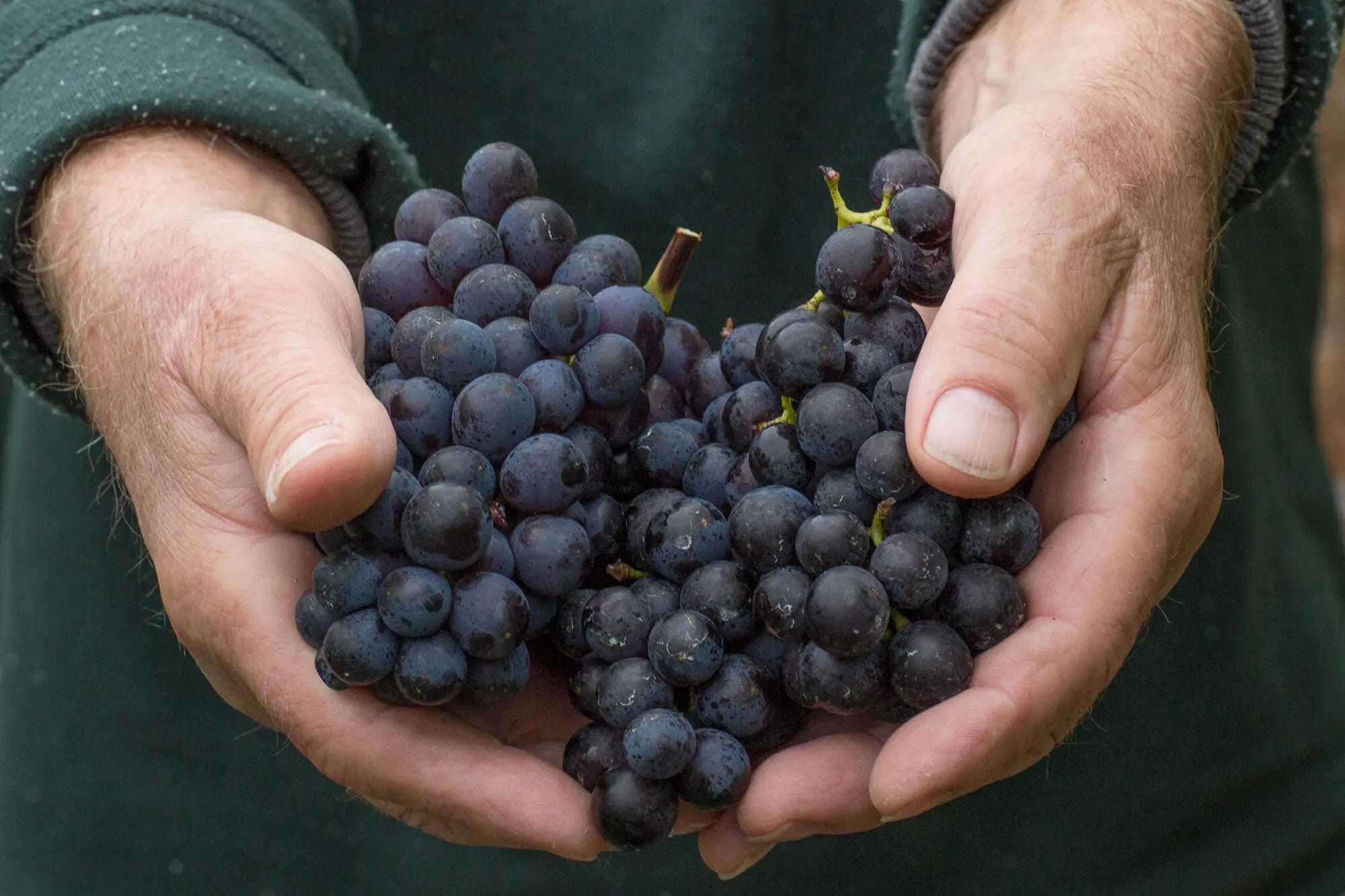
Champagne’s growers have traditionally used red Pinot Noir and Pinot Meunier grapes in their white sparkling wines, and indeed Blanc de Noirs champagnes are made exclusively from red (black) grapes. Most red grapes’ flesh is white, producing white juice. The red colour comes from the skins, darkening the juice during maceration; the skins, along with the pips, also contribute tannins to reds. So if a winemaker presses red grapes carefully, to avoid breaking the skins, she is left with white “must” – juice, though cloudy with residual solids – to make wine with.
Doug Wregg, of specialist low-intervention importer Les Caves de Pyrene, thinks the vogue is part of the wider shift in consumer tastes towards more white and rosé wines from red, as well as the trend in a number of places today towards fresher, lighter reds. He points out that whites were traditionally used to improve some bigger reds in regions such as the Rhône, Tuscany, and Priorat and Ribera del Duero in Spain, until more powerful wines became fashionable from the 1980s. Now he says, “the wheel is turning again. There is a lot of co-plantation and co-fermentation (many natural wine vignerons are into this) to make very light, quaffable reds.”
Blanc de noirs seems to be especially in vogue just now in Greece. The Romeiko I tasted was Manousakis’s “Nostos” 2024: winemaker Afshin Molavi jokes that he used Romeiko “because it’s a shit variety” for red wine – even though he used high-quality, old-vine grapes for this cuvée. In fact, Romeiko is used in Crete to make red, white, rosé and orange wines: it’s a tricky grape but also a shape-shifter.
Less traditionally, some growers in northern Greece are now making white from the local Xinomavro grape, known for its firm tannins when made as a red. “White Xinomavro remains a niche style in Greece but it’s definitely attracting attention,” says Alexandra Badoi, of leading UK Greek importer Maltby & Greek. “Its growth is driven more by winemakers and sommeliers than by mainstream demand — it’s an insider wine that appeals to curiosity, freshness, and originality rather than convention. It’s a way to showcase the grape’s versatility.”
Athanasios Maras says of his Naoussa “Blanc de Noir” Xinomavro 2024 that “it gives a different perspective on the grape.” Andreas Patistis, based in Pelion, told me he made the “Blanc de Noir” Xinomavro NV I tasted simply “because I had a lot of Xinomavro”. But Laurens Hartman, maker of Greece’s finest sparkling wine at Domaine Karanika, in the country’s far northwest, points out that the main reason for a winemaker to choose Blanc de Noirs is the same as for makers of sparkling wines in northern Europe: red grapes simply can’t ripen there every year. He makes his excellent red Xinomavro only in good years in this chilly corner of Greece.
Nick Brewer, winemaker with his wife America at Sussex winery Oastbrook, says something similar of the rise of Blanc de Noirs in England. “The challenge for English vineyards is the huge annual variability of harvests,” he says. “That affects non-vintage sparkling wines less, but for sites that can only manage very light reds some years, I think some people are adopting a strategy of making Blanc de Noirs still wines by default.” That said, even though Oastbrook enjoys a warm micro-climate which allows the Brewers to make still red Pinot Noir from vintage to vintage, they like the way they have the opportunity to make four different expressions of pinot noir – Blanc de Noirs sparkling, still Blanc de Noirs, red and rosé. They have also made a still Blanc de Noirs from Pinot Meunier.
America Brewer adds that the lack of regulation in the UK compared to France especially gives winemakers greater freedom in this respect: “It’s about making something a bit different.” Badoi says that in Greece, “Blanc de noirs is challenging the idea that Xinomavro belongs only in structured, tannic reds and showing what it can do when freed from tradition.”
Yet even in France, there seems to be increased interest in the style. Champagne producer Piper-Heidsieck recently unveiled its still 2023 Hors-Série White Pinot Noir NZ, a collaboration with New Zealand winemaker and famed Sauvignon Blanc specialist Kevin Judd. It uses high-grade Ambonnay Pinot Noir fruit and is labelled as a Côteaux Champenois. Elsewhere French winemakers are making white wines from Merlot and Mourvèdre, though it often has to be labelled as Vin de France, France’s humblest wine designation, because of appellation rules. Meanwhile Merlot bianco is made in Switzerland’s Italian-speaking Ticino canton.
In Oregon it’s a different story again. There, the growing annual phenomenon of wildfires has created huge problems with smoke taint of grapes. This can affect grapes large distances from direct fire damage. Wine made from badly tainted grapes tastes roughly like licking an ashtray. But smoke taint’s effects are far more of a problem with reds, when a winemaker is leaving the must to macerate on smoke-damaged grape skins. Take off the juice and make Blanc de Noirs, and there is much less risk – even though white wines under those conditions still need lab tests to make sure they are smoke free.
In hotter parts of Europe, Blanc de Noirs can also give winemakers the opportunity to make more and fresher whites than they otherwise might – indeed simply to sell more white wine. At a masterclass a few months ago on the wines of Murcia, down Spain’s broiling Mediterranean coast from Alicante, Peter Richards MW showed Bodegas La Purísima’s “Nocturne” Blanc de Noirs 2024. From the denominación of Yecla, it is made from Monastrell (aka Mourvèdre), a notoriously late-ripening grape that normally makes big, burly reds. Yet this white was very pale, fresh and delicate.
“I guess they do it in Murcia because they have so much Monastrell and so doing something new and different makes sense,” says Richards. In this hot region it is often a struggle to keep whites fresh and with decent acidity. “I’m not sure it’s going to be a world-beating category,” he adds, “but it’s an intriguing side-note, especially where quality producers are really trying to do something interesting.”
So what do the wines taste like? For a start, they usually have several degrees less alcohol than reds made from the same grapes: often around 11.5 per cent ABV, because the grapes can be picked when they are less ripe. They have the crispness and freshness you would expect from most dry whites, yet subtly more concentration and texture. Their fruit profile can taste more like a red – hints of raspberry or strawberry fruit in white Pinot Noir, for example – and they can have a slightly richer, rounder mouthfeel. But it’s often difficult to pin down exactly what’s different about this white wine in your glass, and in indeed many people – including wine critics – would simply assume it was a white variety.
Says Wregg, “I think if one jettisons the grape skins and goes for a clean wine, one tends to lose a lot of what the wine is about.” I tend to agree: on balance, I would prefer many of the Blancs de Noirs I’ve tasted if they’d been made as reds. Nevertheless, it’s a neat trick – and a vivid illustration of wine’s infinite permutations of style and flavour.
Six blancs de noirs to try
Black and Wine Blanc de Noirs 2024, IGP Atlantique – this is made from Merlot by a group of co-operatives in Bordeaux’s Entre-Deux-Mers zone and in Duras, to the east. Just 11.5 per cent ABV, it’s very pale, quite aromatic, with a tangy intensity to its fruit. Good value (The Wine Society, £8.25.)
Manousakis “Nostos” Romeiko 2022 – as described above: bright, fresh, citrus and grassy flavours, intense (Maltby & Greek, £22.)
Patistis Blanc de Noir Xinomavro NV, Pelion – a very unusual wine, incorporating a little white Assyrtiko and made in a solera, mixing up vintages. Slightly odd but in a good way: intense, with slight spicy and herbal notes. One to flummox wine friends with in a blind tasting (Maltby & Greek, £22.)
Domaine de l’Accent Blanc de Noirs 2024, Vin de France – this is made by talented Italian winemaker Konrad Pixner in the Languedoc’s Terrasses du Larzac zone, from Mourvèdre. Very pale, with tangy apple fruit on the nose hinting at its hidden heft; bright, clean but focussed, intense energy. Unusual and worth a try, as are Pixner’s other cuvées imported by organic specialist Saison Wines (DVine Cellars, £24.50.)
Oastbrook White Pinot Noir 2023, Sussex – Nick and America Brewer made just 2,500 bottles of still Blanc de Noirs in this vintage. Only 11.5 per cent ABV, it boasts hints of red fruit as well as citrus, firm acidity but well balanced (direct from Oastbrook or at The Online Wine Tasting Club, Our Sommelier, £23.50.)
Weingut Meyer-Näkel “Illusion” Spätburgunder Blanc de Noirs 2022, Ahr – this German wine from Spätburgunder (aka Pinot Noir) is my favourite of these and one of the best still Blanc de Noirs I’ve tasted. It’s from a distinguished producer in the narrow valley of the Ahr, which joins the Rhine to the east. In all honesty I doubt I could guess what it was blind but it has a pronounced red fruit profile, complex and subtle, as well as wonderful purity and balance. Lovely (The Wine Barn, £24.15.)
What I’ve been drinking this week
Weingut Göttelmann Kapellenberg Riesling “Vollmond” 2018 – another white from this week’s impressive tasting by German importer Iris Ellmann’s The Wine Barn (like the Meyer-Näkel above). Utterly gorgeous Riesling from a single vineyard in the Nahe: fresh, delicate, precise, with added depth and complexity from a few years in bottle. Perhaps it’s so reasonably priced because the Nahe is a less well-known region outside of Germany, but for aged Riesling of this quality, this is a steal (The Wine Barn, £17.65.)
Pyramid Valley Chardonnay 2022, North Canterbury – I drank this white with Pyramid Valley’s co-owner, veteran New Zealand winemaker Steve Smith MW, at a dinner with Tim Atkin MW and other wine folk last week. Slight reduction on the nose, but in a good way; zesty, bright citrus fruit, elegant yet creamy, with a deft, toasty lick of oak and considerable depth. A wine to give many white Burgundies at twice the price a run for their money: impressive (All About Wine, Hic! Wine Merchants, Drinks Direct and elsewhere, from £31.29.)
Domaine of the Bee 2021, Maury Sec – I drank this red with its winemaker, Justin Howard-Sneyd MW, at a dinner last week in Roussillon that was part of a fascinating forum on regenerative viticulture hosted by Domaine Lafage (more on that in a future blog). When he’s not working with the Regenerative Viticulture Foundation, Justin makes wines from old vines on small plots high up in the wild Agly valley, which runs parallel to the Pyrenees. This is a Grenache/Carignan blend, dark, spicy, powerful yet so harmonious and smooth – gorgeous (direct from Domaine of the Bee, £26.50.)
Check out my podcast with my friend and Daily Telegraph wine critic, Victoria Moore, Get Yourself a Glass, where we chew over the aftermath of Dry January and ask, is there a crisis in wine? Includes a live tasting of no- and low-alcohol drinks – and some surprising facts about French hospital drinking. Listen on Spotify, Apple or wherever you get your podcasts.
Transparency declaration: all the wines above were free samples or at press tastings.
Facinating deep dive into Blanc de Noirs! I had no idea smoke taint was driving some Oregon winemakers toward this style. Last summer I tried a white Pinot from England and was completly stumped in a blind tasting - kept thinking it was Chablis. The versatility of red grapes never ceases to amaze me.