
Wine’s summer inferno
As wildfires burn out of control in Spain and France, the wine industry and the rest of Europe faces the new normal of climate change. Plus: organic bottles from Saison Wines

The new episode of my Get Yourself a Glass podcast is out! The Greek wine revolution: Victoria Moore and I look at just why Greek wine is so exciting right now, talk to leading players and tell you what to look out for. On Apple, Spotify or wherever you get your podcasts.


Eduardo Rodriguez gestured to scorched trees beyond the winery: “The fire was right here – we were lucky not to be touched. The wind carried the fire away from us and the vines acted as firebreak.” When in November last year Rodriguez showed me around the Gargalo winery in Monterrei, Galicia, almost on the Portugese border, the scars of that summer’s huge local wildfires were still painfully evident.
Some winemakers in California’s Napa Valley have had even luckier recent escapes. “We drove through the fire in two cars, hoping at least one of us would survive,” Chris Howell told British journalist Adam Lechmere of his and his wife’s escape from Cain Winery, Napa. It was during September 2020’s notorious Glass Fire: “You could feel the heat radiating from the burning half a mile away. And the sound of it… Like an army of jet engines – an astonishing roar of hot wind.”
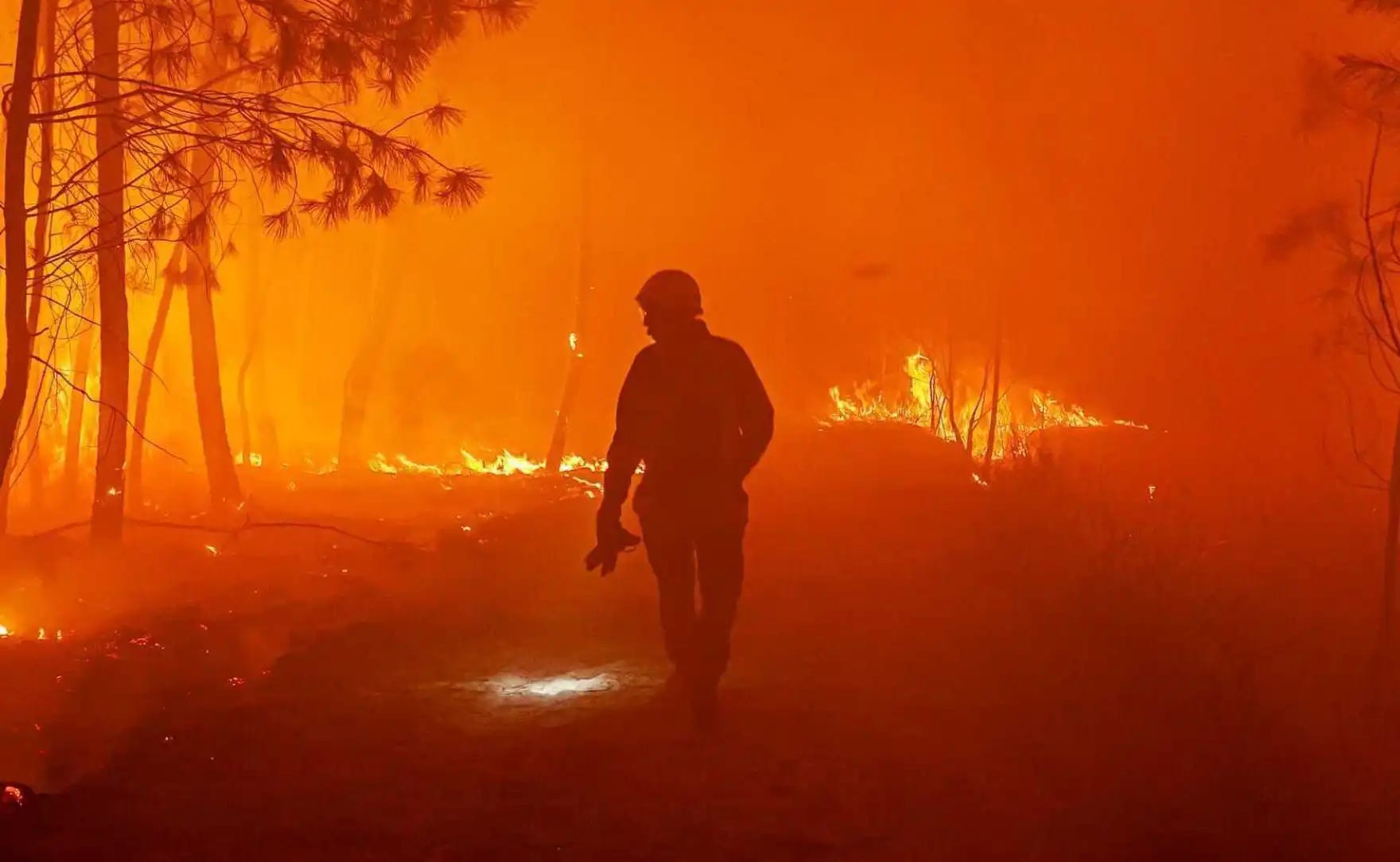
Now local residents, including wine producers, are again threatened with mortal danger as wildfires sweep Spain and France. Parts of the Gironde fire are raging less than ten kilometres from the western edge of the Haut-Médoc vineyards, and little more than that from the western suburbs of Bordeaux itself. At the time of writing, firefighters were still battling to prevent fire spreading east towards the city, while their Spanish counterparts fight huge blazes west of Madrid.
Meanwhile wildfires have raged elsewhere in France, in Portugal and in Greece – to say nothing of the Cairngorms and other places across Britain. Incredibly, wildfires now pose a threat even in London. On one evening in the past week, the London Fire Brigade was called to three separate grass fires that burnt a total of four hectares, while in July 2022, a grass fire destroyed nearly 20 homes in Wennington, East London.
Welcome to the new face of climate change: not just crazily hot summer days, not merely sudden downpours and hail, but large-scale destruction and terror. I remember in August 2022 being transfixed by this realisation that I was watching the climate emergency unfold before my very eyes. I was driving north from Bordeaux on the A10 motorway and passed a convoy of German fire engines speeding in the opposite direction to tackle huge wildfires southwest of the city. The day before, we had sweated in St Emilion in temperatures of 39℃.
French firefighters are hampered by a new nightmare phenomenon already known in California and Australia: “pyrocumulonimbus” or “fire clouds” that effectively start to create a big fire’s own weather system. Massive heat generated by the fire carries smoke and water vapour high into the atmosphere, where it condenses into vast cumulonimbus storm clouds. These then create high winds and can trigger lightning that sets new areas alight.
It’s not just Europe burning this summer. In June, the Putah Fire incinerated hundreds of acres close to the northern California wine country. This month, dozens of fires have burned in Oregon. The Okanagan Valley, in Canada’s British Columbia, is currently at high risk from high temperatures and lightning, following catastrophic fires in August 2023.
And during Australia’s summer, in January this year, wildfires tore through central Victoria, damaging vineyards in the Strathbogie Ranges. Elsewhere in the southern hemisphere, Chile’s Itata and Bio-Bio wine regions were hit by blazes after high temperatures and drought – just three years after mega-fires ravaged those regions and Maule. In January, thousands of people were evacuated after huge fires burned in South Africa’s Western Cape, damaging vineyards in Stellenbosch, Paarl and elsewhere.
People are more important than wine: I hope that the brave firefighters stop anyone else dying in these fires, whatever happens to the vines and the wine. Nevertheless, the effects of climate change-driven fires on the wine industry are one grim indicator of the sort of challenges we now face.
Wildfires are a natural phenomenon in some landscapes, especially wine-friendly ones like the Mediterranean and California. Some plants in these environments even benefit from seasonal fires, which remove undergrowth and shade and give seedlings sunlight and nutrients. Certain trees, such as the lodgepole pine, depend on the heat of fires to melt the hard resin keeping their cones shut, to scatter their seeds.
People in the Mediterranean basin lived with such seasonal fires historically by farming the land in mosaics, where tilled land acted as a firebreak to fires that started in neighbouring patches of forest. Traditional practices such as coppicing also thinned out forest and reduced the amount of available fuel for fires.
Yet rural Spain, especially, has suffered years of depopulation – the phenomenon known there as España vaciada (“emptied Spain”.) In places like Galicia, rural depopulation means that less land is cultivated and more reverts to brush and undergrowth. Last year’s wildfires in Galicia were some of the worst ever because a wet winter was followed by an early growing season and a very hot, dry summer, encouraging undergrowth and then drying it out by the start of the fire season. Put that together with much hotter summer temperatures, and local people face far greater fire danger than did their grandparents.
Modern mega-fires are on different scale, emerging from the 1980s and 90s as climate change started to drive hotter temperatures and longer droughts. Experts also point to the effect in forests of years of the authorities suppressing fires rather than allowing them to burn seasonally, so that dead wood and undergrowth build up. That is fuel for mega-fires, generally classified as those covering at least 5,000 hectares or emitting more than 10,000 kilowatts of energy per square meter (by comparison, a small brush fire generates around 100 kilowatts/m₂.) Big fires are not necessarily megafires, though last year’s blazes in Galicia destroyed nearly 120,000 ha. But the Gironde is indeed in the grip of a megafire, which has already destroyed more than 42,000 ha (an area roughly four times the size of Paris).
For winemakers, the challenge is not just the destruction to crops and buildings, or the health risks posed by smoke to vineyard workers. Smoke is also a serious threat to the grapes, especially red ones, in the shape of smoke taint. It can damage wine quality, slash yields and even mean that whole vintages have to be written off.
One problem is that it’s hard to spot it ahead of making the wine. Smoke damages grapes because they absorb airborne volatile phenols through their skins. These compounds bind to natural sugars in the grape, forming odourless glycosides. This is important because it means the effect cannot be tasted in the raw fruit: the smoke taint emerges only after fermentation, when the fermentation temperature and the wine’s low pH breaks down the glycosides to release burnt, ashy flavours. As Washington winemaker Caleb Foster told Wine Enthusiast magazine, “tasting grapes tells you absolutely nothing. Yummy-tasting grapes can be smoked.” Chemical technologies have been developed to reverse the process, but they are expensive and don’t work very well.
I came across the problem first-hand last autumn in Galicia. Several rows of vines at Jesús Varela’s Trasdovento vineyards were burnt by last August’s big wildfire in Monterrei, the fourth fire there in the past decade. In the burnt patches, you could still smell smoke. “We were surrounded by smoke for three days,” says Varela. He decided to harvest his red Mencía grapes anyway and see how the wines turned out. But while it’s easier to get away with minor damage in white grapes, which are quickly pressed, the effects are much starker in reds, where the must macerates on the grapes’ skins for weeks.
Standing in his winery, Varela poured off samples of his white blends; I couldn’t detect any smoke flavour in them. Then he handed me a glass of each of three batches of red, straight from the stainless-steel tanks. I lifted the first to my nose: an acrid, burnt note. For a moment I wasn’t sure what to say diplomatically, especially in Spanish, but Varela must have seen my face. He smiled sadly: “It’s affected [tocado – lit. touched], isn’t it?” The next red was even worse, like licking an ashtray; none of the three were drinkable. I felt awful for him.
The only way to tell for sure if wine is affected by smoke-tainted grapes is using a lab analysis. Fifty kilometres northeast, in the Valdeorras region, O Luar do Sil winemaker David Pascual told me he had sent their white Godello grapes for testing. Looking across from the winery, whole mountainsides opposite were blackened. “This fire was the worst yet, and the first time for us where there has been a risk of taint,” said Pascual.
Indeed some winemakers on the US West coast and in Australia report smoke damage to vines hundreds of kilometres from major fires – even though vines closer to the fires suffered no damage.
Part of what is so daunting about the new fire risk is this: we are going to have to live with these sorts of challenges now for decades, regardless of what measures we adopt to tackle climate change. Wine producers could and should take action including switching to renewable energy, conserving water and cutting the carbon footprint of their packaging. But that won’t lessen the danger of wildfires next year or in five years’ time. And even if whole economies adopted such strategies – and I believe they should – that will not reverse the climate change effects that we’re seeing for years yet.
It might stop the chaos getting any worse, and eventually – perhaps in half a century or so – our climate might start to return to normal. Until then, we and our children face many years of dealing with broiling heat and extreme weather. Some of the damage can be repaired: “we’ll have to re-plant the first few rows,” says Varela philosophically, gesturing at the charred remains at the edge of one of his vineyards. But for the time being, wildfires are the new normal for winemakers and many others across the world.
My recent book with Jane Masters MW, Rooted in Change: The Stories Behind Sustainable Wine, looks in much more detail at the challenges for wine of climate change, including wildfires.
What I’ve been drinking recently: Saison Wines
Months ago I attended a fascinating tasting organised by Daphne Teremetz, an Anglo-French former Waitrose buyer who has launched her own importing business, Saison Wines. Her wines are all French and all certified organic. I meant to write it up but didn’t get around to it; since then I’ve come across them on a couple of wine lists and at independent stores and remembered how good they were. She has a fair spread from across France, though some of the most impressive I tasted were those from the Languedoc, which is where the following are from.
Domaine de L’Accent “Accenteur” 2024, AOC St Guihelm le Desert – from the high Larzac plateau, this is made by Italian winemaker Konrad Pixner. It’s a very Languedoc blend of Carignan Blanc, Carignan Gris, Bourboulenc and Marsanne, with a touch of oak as half of it was aged in used foudres (550-litre barrels). Mineral, fresh, herby, taut, long: distinctive and unusual – really worth trying. The same producer’s “Cuvée Elliot” 2023, AOC Terrasses du Larzac is also a superb red Languedoc blend (The Sourcing Table, Dvine Cellars, from £21.90.)
Domaine de Bon Augure “Aux Innocents Les Mains Pleines” 2024, IGP Haute Vallée de L’Orb – from a fantastically obscure Languedoc designation, this is an orange wine made from Pinot Gris, Grenache Gris and Sauvignon Gris. The name is a French expression that means something like “beginner’s luck”. Fresh, clean – not at all funky, despite minimal added SO₂ – with wonderful orange blossom notes, delicate fruit and spice. One of the best orange wines I’ve had in a long time (Dvine Cellars, Hop Burns & Black, from £20. It has also been in The Sourcing Table recently.)
Domaine Caihol Gautran “Sine Quano” 2024, IGP Côtes du Brian – despite the comedy IGP name (which I confess I’d never come across before), this is essentially a Minervois, but it’s 100 per cent Carignan. Despite the fact that it’s a resolutely natural wine with no added sulphur dioxide, it doesn’t taste it (I actually wonder whether it might just be too delicious and un-funky for some die-hard natural-wine partisans.) Light, bursting with lovely fresh, bright red fruit underpinned with a line of minerality. Just gorgeous (Dvine Cellars, £19.50)
It seems unimaginable that Bordeaux can escape smoke taint in this vintage and yet in all the coverage I've heard on radio and seen on TV I've heard nothing about the threat to the wine.